Showing posts with label fiction. Show all posts

Thursday, January 5, 2012

Monsters of Men by Patrick Ness

Published: 2010
Format: eBook
Genre: YA fiction
Series: Chaos Walking book 3

Three armies march on New Prentisstown, each one intent on destroying the others. Todd and Viola are caught in the middle, with no chance of escape. As the battles commence, how can they hope to stop the fighting? How can there be peace when they’re so hopelessly outnumbered? And if war makes monsters of men, what terrible choices await?. But then a third voice breaks into the battle, one bent on revenge… (patrickness.com)

It's been such a long time since I read the first two books in this series. When I finished The Ask and the Answer, Monsters of Men wasn't even released - and I'm only getting to read it now. If you're familiar with this series, you know that each book pretty much starts off where the previous one left off. It's one continuous, seamless story. If you're able to read all three consecutively this is a really cool experience! If, like me, you wait over a year to continue the adventure, some of the spark is unfortunately lost in the process.

Everything about this series is marvellous: the characters are deep and genuine, the writing is unlike anything I've come across, and the plot is, to be frank, really cool. A connection is formed with each person in the story, and the book quickly absorbs you into its world. This is what made me fall in love with the first two books, but it sadly contributed to my disappointment with Monsters of Men. I almost feel guilty criticizing the book in this way, because it's partly my fault that I waited this long to read it. I lost the connection with each amazingly complex character. I lost the connection with the frightening world that Ness created. I lost the connection with the series itself, and found myself not caring about the fate of Todd and Viola.

I must admit: once I got about half way through the book my morale improved a bit, but I don't think I appreciated the book like it deserves to be appreciated. There's a lot of fighting in Monsters of Men, and I totally wasn't following. I couldn't distinguish one fight from the next, and the end goal was totally unimportant to me. Characters died, momentous events happened, yet it didn't seem to matter to me. What a contrast compared to how I felt reading the two first books!

In the end, I like the conclusion to this epic series. It wasn't too perfect, and it wasn't too depressing. Just the right balance, just the right feeling left with you. Looking back, I won't be able to forgive myself for potentially ruining Monsters of Men! I should have re-read the previous books, but there just isn't enough time in the day. So please, do not let this review scare you away from these book - the series as a whole is absolutely fabulous. Unlike anything I've ever (or will ever) read. Ness touches upon extremely relevant topics and morals while fabrication such unique characters. Despite my disappointment with Monsters of Men, the Chaos Walking trilogy will always hold a special place in my heart.

Related links:
Review: The Knife of Never Letting Go
Review: The Ask and the Answer

Friday, September 10, 2010

The Almond Picker by Simonetta Agnello Hornby

Published: 2002
Pages: 315
Genre: Adult fiction

Who was Mennulara? As the servant of the wealthy Alfallipe family, she made many impressions on people during her life. But was she simply the servant, or did she have deeper connections? Why was the mafia leader at her funeral? Why was she so wealthy? Why did she have such a high status in the family that she served?

This is an especially hard book to review for a couple of reasons. First of all, I haven't had the chance to devote a lot of time time to reading it. The book was a bit spaced out, and I feel like my enjoyment suffered because of it. Second, the nature of the book is so strange, and I'm not used to reading material like this! Let me elaborate on that.

The Almond Picker was translated from Italian in 2005 (which leads me to wonder how it would be possible to translate an entire book and not twist the author's meaning - that has always fascinated me). The story takes place during the course of the two or so weeks following the death of Mennulara. We are thrown into the past as each character remembers their experiences with this mysterious woman, some of which are horrifying and totally unexpected. The way the book is written is really cool, because Mennulara feels like the main character even though she's not alive. There's no way we can trust the memories of the various people, and that makes it all so exciting!

This book's strength clearly lies in its characters. And were they ever abundant! Like a big, fictional Italian family. The dynamics were there, the emotions were there, and the feuds were certainly there. Mimicking real life, certain people had issues that were long buried in the past and forgotten. It's only because of the present circumstances that we get to be spectators in this scandalous, mysterious, and slightly disturbing showcase of personal demons. It was a complex web of characters, but Hornby is an expert at making it make sense.

Despite a rather dry plot, The Almond Picker is a true gem. I don't know if it's because of the Italian-ness, but the book felt like a whole new level of literature. The ending is extremely open-ended, but there's no way to figure out the truths if the person involved is dead. Isn't that cool? I love unreliability in books, and was totally entranced by this one. I suggest you try it out of you aren't dependent on a fast-paced plot. Enjoy!

Monday, August 30, 2010

The Russian Dreambook of Color and Flight
by Gina Ochsner

Published: 2009
Pages: 370
Genre: Fantasy?
Tanya carries a notebook wherever she goes, recording her observations and her dreams of finding love and escaping her job at the All-Russia All-Cosmopolitan Museum, a place which holds a fantastic and terrible collection of art knockoffs created using the tools at hand. When the museum’s director hears of a mysterious American group seeking to fund art in Russia, it looks like she might get her chance at a better life, if she can only convince them of the collection’s worth. With the help of her grandmother, friends and the ghost of a man who committed suicide, Tanya tries to turn her life around (from Goodreads).
I hate to say it, but I don't know what to think of this book. I really don't. There were moments of confusion, moments of disgust, moments of appreciation, and moments where I wanted to give up and never think of the book again. I made it to the end, though! My opinion of The Russian Dreambook did miraculously improve during the course of reading it, but I still cannot say that this is a book that will go down in history for me.

The book is written in a format where we alternate point of views. This was a likely source of confusion for me, because all of the characters are somehow related - but their stories stand alone. Even though it was a neat experience to live post-Soviet Russian in the shoes of different people, some of it seemed irrelevant. A waste of time. The characterization was phenomenal, but what good does that serve when it doesn't really matter in the end? At least, that's what it felt like to me. On top of that, there were moments in The Russian Dreambook where I had no idea if the character was in a dream or in real life - the whole book has an atmosphere of darkness, whimsy, and fantasy that was somewhat misleading.

As I said before, these are some of the most honest, raw characters ever. Living in such hard times and poverty, we get to see the most inner and suppressed human emotions and feelings which are so very accurate. I was disgusted by their often crude and brutal behaviours towards each other, but what else can be expected from people living in such a world? Despite all this, I questioned why some of the characters even existed. Many of them felt like mere distractions.

The Russian Dreambook of Color and Flight is one of those books that is probably better the second time around (I hope, at least). In the end I was relatively satisfied with my "literary journey", but I still feel like I missed what Ochsner was trying to accomplish. To me, this was more of a showcase of brilliant characterization rather than a poignant and meaningful book. Looking at it now, it feels as if there's some sort of magical aura surrounding, making me want to love and understand it. Regretfully, that didn't happen.

Thursday, August 26, 2010

Family Sold Separately by Kate Long

Published: 2005
Pages: 326
Genre: YA fiction
Katherine is on the verge of turning eighteen and is living with her grandmother. Friendless, loveless and overweight, she does not have high hopes for her future. Will a chance to study at Oxford convince her grandmother to let her leave? Or, even better, when a mysterious boy shows up and claims to be her cousin, will Katherine finally learn more about her parents?

Ah, such British fun. Family Sold Separately is witty, sarcastic and smart. Despite the various laugh-out-loud moments and the absolutely wonderful main character, I kind of stopped caring plot-wise at around the half way mark. I don't know what caused this, now that I think back. Was it because I was getting lost in the slang? I couldn't tell you. But I can tell you this - Family Sold Separately has a loose (maybe even weak) plot, but the dialogue and authentic characters will make you fall in love.

I've read another book by Kate Long in the past, and one thing is certain: she seems to be consistent in creating real, tangible characters. They all have their faults, strengths, and problems that don't feel far-fetched in the least. It's refreshing to read about an overweight girl who's living with her grandmother, and is unsure about her future. At the age that she is, it's natural to questions your purpose in life. It's natural to be debating what university you want to go to. It's natural to want to leave your old, boring life behind. Nothing is masked in Family Sold Separately, and that's something that I appreciated. After all, real life isn't as easy as many books make it out to be.

The dialogue in this book was fantastic. There were sprinkles of sarcasm here and there, bits of comedy thrown in for good measure, and smart little comments that made me smile. Katherine's grandmother, Poll, is cruel and harsh. Seeing those two people collide was so, so entertaining! Then you have "Dogman", a semi-perverted man who is a friend of Poll's and is a regular visitor of the house. The comments that Katherine directs towards him under her breath are too funny! I would write some of them down for you to see, but they would be out of context and I'm afraid their full effects wouldn't be shown.

As I said before, the plot kind of slipped away at a certain point in the book. It became a backdrop to the lovable, funny characters that truly brought Family Sold Separately to life. I will admit - I was a bit disappointed that I didn't get more involved in the "meat" of the book, but I had so much fun along the way! Pure charm.

Monday, August 23, 2010

A Good and Happy Child by Justin Evans

Published: 2007
Pages: 320
Genre: Thriller
As an adult, George Davies can't bring himself to hold or be around his child. His fed-up wife sends him to a therapist, and together they delve into his disturbed childhood. George believed he was possessed by a demon, and this served as the link to his late father. But was this really the issue? Were the hallucinations and visions real?

Wow, what a weird/disturbing/thought-provoking book. To be honest, I had no previous knowledge of what this book was actually about. Sure, I knew it involved a man who was severely affected by his experiences as a child. Sure, I knew his father died mysteriously. But demons? Exorcisms? I didn't see that coming. All of it was surprisingly interesting, and it even scared me a bit.

This is a psychological thriller at its finest. The book isn't action packed by any means, and I wouldn't consider it a classic, fast-paced thriller. A Good and Happy Child is more of a subtle thriller - one that slowly creeps up on you. One thing that I really, really liked was how you couldn't fully trust the point of view of the narrator. George was truly a messed up child, and was having serious hallucinations that (might) have caused him to injure many people in many ways. As the reader, how could I be sure that he was mentally ill? Or was it the demon? I loved being unsure. The episodes that George was having of his "friend", and when his "friend" was telling him to do things, were so frightening. I'm telling you now - reading this book at midnight was not a comforting experience!

As for the writing, I wasn't overly impressed. I mean, Evans' style was a tad dry, but it fit perfectly with the book. There were the occasional moments when I savoured his descriptions and really got what he was saying, but they weren't happening all the time. It didn't matter, though, because I was so caught-up in the story that I barely noticed how his writing affected me. He did manage to invent some pretty interesting characters, especially in George. I loved his character, despite its strangeness. I kept forgetting how he was only eleven years old, because his intelligence and maturity was beyond his years. His thoughts and experiences were so haunting.

Don't worry - you don't have to be religious or believe in demons to take this book seriously. I can't tell you what happens, but there are so many events that got my heart beating faster. Nothing is settled in this book, nothing is finalized. It's all open to interpretation, and the ending is totally up to you.

Thursday, August 19, 2010

The Girl She Used to Be by David Cristofano

Published: 2009
Pages: 241
Genre: Fiction
Melody can never live a normal life. At six years old, she witnessed a violent crime along with her mother and father, and her family becomes a target due to what they saw. Twenty years later, she's an orphan, constantly changing names, constantly moving, and constantly re-inventing her life. As part of the Witness Protection Program, her safety is never guaranteed. But when a man appears and promises her safety and truth, how can she not trust him?
Gorgeous book. Gorgeous, gorgeous book. And what a great library find! Truthfully, I enjoyed almost every moment of The Girl She Used to Be. Despite the scattered cheesy moments, it offers such a unique, interesting twist on those classic "self-discovery" books. It has action, it has adventure, it has intrigue, mystery, romance, substance, and honesty.

The fact that Melody literally doesn't know who she's supposed to be scares me so much. I mean, imagine not being able to stay in a certain town long enough to get an education, get a steady job, meet someone, and live your life? It's an utter mess. And it's depressing. It's weird. Strange. But Melody has to live this lie all the time, and it was so easy to empathize with her. I've never read a book where someone was so deeply lost in life - her anguish was contagious. And then, much to my happiness, we were presented with an adventure of sorts! I don't want to say much, but it felt oh so risky and a tad rebellious. Fun!

One thing that really made this book was Cristofano's writing. It was like velvet. Not necessarily in the beautiful-and-elegant-description-on-every-page kind of way, but in the way that makes you say "yes, this feels right". I loved the sarcasm, I loved the spunk, and it was great being inside Melody's intelligent yet wild head! Of course, there were the classic movie romance scenes. But even these were relatively sparse and it didn't feel like they ruined the story in a noticeable way. I could do without them, though.

The characters were, all in all, good. Melody was the most realistic, and the secondary character could have used a bit more personality in my opinion. I did find it a bit odd how they fell for each other so quickly, though! Don't worry - this isn't a spoiler at all. I'm pretty sure every person will be able to see it coming. Still, it's so sudden! I literally turned the page and there they were, gazing into each other's eyes. I thought they were enemies? I thought they had a history?

I'm being really picky here, but that's only because I liked this book so much. I feel the need to be critical! The Girl She Used to Be was a wild ride, and it was so much fun. Short and sweet. The way it should be.

Wednesday, August 18, 2010

The Forgotten Garden by Kate Morton

Published: 2008
Pages: 549
Genre: Fiction
A tiny girl is abandoned on a ship headed for Australia in 1913. She arrives completely alone with nothing but a small suitcase containing a few clothes and a single book - a beautiful volume of fairytales. She is taken in by the dockmaster and his wife and raised as their own. On her twenty-first birthday, they tell her the truth, and with her sense of self shattered and very little to go on, "Nell" sets out to trace her real identity. But it's not until her granddaughter, Cassandra, takes up the search after Nell's death that all the pieces of the puzzle are assembled. (from back of book)
This is one of those books that I've been considering for a long time. I first saw it at the book store, picked it up, read the back, and decided not to get it. I saw it for a second time at the used book store and splurged! (Well, not really. It was cheap.) While The Forgotten Garden wasn't a mind-blowing masterpiece, it kept me involved, invested and interested!

We all know that I adore mysteries. So when the mystery in The Forgotten Garden started picking up, it was great to be a part of it. I loved how the point of view was constantly switching, and rotating between three different time periods. It was neat, actually, because we sometimes had knowledge that other characters didn't have at that point. Don't you just love feeling sneaky like that? I did. Being thrown back in time for a few chapters, and then being transported to the future for a couple more, was oh so fun.

Morton's writing had its ups and downs for sure. At times I loved her exquisite imagery and flowy (not sure if that's a word...), smooth descriptions. But at other times, it simply felt repetitive! I noticed that she tends to use some of the same words over and over again. Once I clued into this, her writing sadly lost some of its luster for me. It was still beautiful, but there were no more surprises. I don't know if it's just me, but I also felt that Morton over described certain scenes. There's a fine line between a delicate, perfectly described scene and one that feels too stressed. I think this line was crossed at a few instances during The Forgotten Garden, but for the most part I loved Morton's writing. I soaked it up!

I'd like to discuss the plot of the book in more detail, because this was the main strength of the novel for me. There were so many connections between characters, so much history, so many secrets, so many emotions long buried in the past. Being able to uncover all this along with Cassandra was so great! But it wasn't only with her that we got to learn about things - as I mentioned before, going back in time to see things as they truly happened was such an interesting way to get involved in the story. Through three generations, I was there when everything happened. What a cool feeling!

The Forgotten Garden was, for me, a solid read. It had its faults and wasn't perfect by any means, but the story was just so entertaining! I loved the format, I loved the book's style, and I loved the characters.

Recommendation: Give this one a try! Especially if you're one who loves family mysteries and historical stuff like that.

Wednesday, August 11, 2010

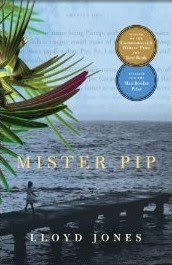
Mister Pip by Lloyd Jones

Published: 2007
Pages: 256
Genre: Fiction
Matilda is a young girl living on a copper-rich island with her family and other villagers. When their home is torn apart by war, Matilda's father flees the island, along with the school teachers and other people. There's only one white man left, a man named Mr. Watts. He decides to teach the children all that he knows, and immerses them in the world of Charles Dickens' Great Expectations.

This is the ultimate book lover's novel, for a couple of reasons: it's all about the classic Great Expectations (which I sadly have not read yet), it explores the power of reading, and it's a super poignant, unique book. How could I resist not buying it on a whim? As you can see, I couldn't. I didn't. And I'm so happy for that.

For such a short book, Jones was able to pack so much goodness into it. The language he uses is so simple it's on the brink of being childlike. But there's no need for complexity in a book like this. It's written in a very honest, truthful tone that perfectly reflects the feelings, desires, wants, needs, and thoughts of Matilda. Once she discovers her love for Great Expectations, she clings on to it as a means of escape from the violence and heartbreak of her everyday life. It gives her permission to dream, permission to hate, and permission to want to get away. I loved the way Jones showed this to us as readers.

I know that one big factor in this book was supposed to be the teacher, Mr. Watts. I think I was supposed to be entranced by him, and find his morals and views of the world very interesting. I didn't, really. To me, the magic of this book wasn't in him at all - it was in what he showed to the children. He showed them that it's important to have an imagination, to appreciate what books have to tell us, and to realise that you can learn a lot from the characters and relate to them as real people. I could be totally off in this respect, but that's what I felt. And, after all, that's what Mister Pip is urging you to do - take away what you want, what you need, from books.

As you can probably assume, there isn't one fixed, set in stone message to take away from Mister Pip. You shouldn't simply read the book with the sole aspiration of being taught a lesson. Yes, you can follow Matilda with her journey of being enlightened and having the courage to face the world she lives in. Or, you can let the book work its magic on you. All I know for sure, though, is that Mister Pip will probably leave an impression on you. It's hard to tell what that impression is, but it's there.

Recommendation: If you love and appreciate books (and I'm guessing you do), read Mister Pip. It's such a great experience that will touch you as a reader! If you've read Great Expectations by Charles Dickens, that will be an added bonus.

Monday, August 9, 2010

Fixing Shadows by Susan Barrett

Published: 2005
Pages: 376
Genre: Fiction
One evening, the Duchess of Fainhope gives birth to a son, the heir of the empire. That same night, the governess, Miss Mantilla, gives birth to a son of her own. When the Duchess' son dies hours later, the living son is swapped and presented as the dead. What follows is a detailed account of the lives of these two women, the son, and the people that surround them.

What first drew me to this book was its gorgeous cover. And let me tell you - it's even more eye-catching in real life. Other than that, though, I was drawn to the book because of the summary on the back cover. It promised scandal, lies, twists, love, and good ol' Victorian fun. While it delivered on all these promises, reading Fixing Shadows was not simply a walk in the park.

In keeping with the time frame of the novel, Susan Barrett's prose is formal, old-fashioned, and very English. It took me a few chapters to get used to this, and I found that I had to be fully focused on the book while reading. Fixing Shadows and distractions do not mix very well is what I soon discovered. Now, her writing can be quite beautiful and rich at times, but (at least to me) it did tend to become monotonous and slightly boring on occasion. There are a lot of purely descriptive parts in the book, and this is where I zoned out and started skimming. That's a habit that I am not proud of, but who can blame me? I wanted to get to the good, juicy parts! Enough with all this useless (but not really) description.

I love, love, love the originality and creativity that went into the plot and characters. Fixing Shadows probably has one of the most complex and hard-to-follow plots I've ever read, but it's not sloppy at all. Everything fits, everything works. Since the book mostly takes place in London, some characters speak in a way that was extremely difficult to understand. I didn't appreciate this aspect at all, and found myself once again skimming these parts. But I realise that Barrett wanted to accurately depict life back then, and this was part of the overall atmosphere. If you can get past the severe English-ness of the book, you'll most likely fall in love with the wide array of characters.

To wrap this all up and get all my opinions in check, I can safely say that Fixing Shadows was a successful read. It wasn't necessarily a page-turner, it wasn't a fast read, and it was a bit confusing at times. If you pay attention, take the time to savour Barrett's lovely and delicate writing, get invested in the plot, and get to know the characters, Fixing Shadows will turn out to be a dark, haunting, but very solid read.

Recommendation: Like I said before, this book is well-suited for someone who enjoys Victorian books, isn't turned off by a complex plot, and can handle formal and (occasionally) stiff writing.

Wednesday, August 4, 2010

The House on Mango Street by Sandra Cisneros

Published: 1984
Pages: 110
Genre: YA fiction
Sometimes heartbreaking, sometimes deeply joyous, The House on Mango Street tells the story of Esperanza Cordero, whose neighborhood is one of harsh realities and beauty. Esperanza doesn't want to belong - not to her rundown neighborhood, and not to the low expectations the world has for her. Esperenza's story is that of a young girl coming into her power, and inventing for herself what she will become. (from back of book)
I guess you could say that I had relatively high hopes for this book. The summary lead me to believe that I'd gain a lot from reading it - empathy, understanding, appreciation, and strength. But, I didn't. I'm sure The House on Mango Street has many underlying themes and messages that a more critical and analytical reader could discover, but none of them came across for me!

Cisneros is talented writer, that's for sure. She also writes poetry, so some of that smoothness and richness was there. I liked the innocence of the narrator, and I liked seeing the world from her eyes. Despite all that, the book just didn't make logical sense to me. The "chapters" were short, fragmented, random, and didn't merge to create one single plot. Rather, they felt like their own separate short stories that had no relevance to each other in the least. And, to top it all off, none of the characters stood out. I found it difficult to distinguish them from each other.

Maybe the book's brevity ruined it for me. Maybe I didn't take it seriously enough. Maybe I even read too fast for my own good. No matter what, though, The House on Mango Street will not go down in history for me. It was a semi-positive, semi-uplifting story about a young girl who decides to leave her old life behind - that's pretty much the gist of it. Sandra Cisneros is a good author herself, but I don't think this book showcased her full potential.

Recommendation: Because you can theoretically read this book in just over an hour, give it a try if you see it anywhere. You might end up appreciating it more than I did, so I don't want to discourage you from reading it.

Monday, August 2, 2010

Broken by Daniel Clay

Published: 2008
Pages: 304
Genre: YA fiction
Skunk Cunningham has a loving dad, an absent mother, and a brother who plays more Xbox than is good for him. She has a crush on her teacher, Mr. Jeffries, and fond feelings for Mrs. Buckley, who lives across the street and always has time for her questions. But Skunk also has the neighbours from hell: the five Oswald girls and their thuggish dad, Bob, are vicious bullies whose reign of terror extends unchallenged over their otherwise quiet suburban square. (from back of book)
This is one of those books that is filled with countless tragedies. Nothing good ever seems to happen at all during the course of the story. But, if you can look past this constant morbid atmosphere, Broken does have a lot to offer in terms of writing, themes and messages.

The book is written in an odd way, in fact. There are no chapters, so the book feels like one long, continuous story. We alternate narrators at different points in the story: from the point of view of Skunk, a curious and intelligent young girl (who reminds me a lot of Scout from To Kill a Mockingbird), to a third person point of view. One of the things I hear a lot from people is that they usually don't feel they can connect with the characters when a story is not written from first person. Broken proves otherwise. Daniel Clay is an expert at letting us enter the minds of his characters - from the mentally unstable and "broken" Rick Buckley, to the violent and dangerous Bob Oswald, to the naive and innocent Skunk, who just wants to understand the world that surrounds her. I really, really enjoyed the psychological aspect of Broken, and oddly felt a bit more educated when I finished reading.

I love the way Daniel Clay writes. It's simple, straightforward, insightful, and is sometimes weirdly structured and feels a bit choppy. But it works. And it fits with the book beautifully.

"If Dillon could just move his head to the water... But he couldn't move his lips. Or his head. Or his hands. Or his feet. He was tied. Dillon was tied. He was gagged."

What else can I say about his writing? Not much, except that it's great for getting inside his characters' heads. Their thoughts and feelings aren't altered to sound more philosophical, or deeper, or more important. They're laid out in plain sight for the reader to take what they want from it. At times it's disturbing and creepy, but that's all part of what makes the book what it is.

The plot, as I said before, is very dark and borderline depressing. We have a maniac, violent, capable-of-murder family living across the street, a stuck-in-a-rut Mr. Jeffries, a hobo child, and a severely mentally-scarred young man who doesn't leave his room. What good could possibly come from that? And, to tell you the truth, no good does. I appreciated the originality and intriguing-ness of the story, but couldn't help but feel slightly sad whenever I picked the book up to read. That's fine, though, because if Broken was filled with lollipops and rainbows, the message would not come across as Clay intended.

Recommendation: If you're someone who isn't bothered by a plot with almost no happiness, give Broken a shot. It's a unique read that is sure to leave a mark.

Saturday, July 31, 2010

The Silver Needle Murder by Laura Childs

Published: 2008
Pages: 260
Genre: Mystery
Series: Tea Shop Mystery book 9
Theodosia browning and the Indigo Tea Shop staff are chosen to cater the town's biggest event yet - the Charleston Film Festival. Busy as ever, there's almost no time to relax! But, on opening night, when a famous film director is shot in from of the whole crowd, things start to go downhill. Now, Theo helps solve the case while discovering juicy secrets and shocking information that will help catch the criminal.
Honestly, how could you not love this series? They're cute, comforting, and relaxing books to read. I'll be the first to admit that the quality of the mystery might not be the highest, but The Silver Needle Murder will draw you in simply with its charm. It was a quick and straightforward book that wasn't necessarily suspenseful, but I loved it all the same.

Take a simple mystery, add a tea shop into the mix, throw in a few lovely characters, a generous dose of small town charm, and what do you get? As lame as that sounds, the result is The Silver Needle Murder. How could you not fall in love with a book that revolves around the comforts of tea? I found it hard not to. Child's writing is dainty, sarcastic when it needs to be, and couldn't be more well-suited for this type of book. Her characters, while not exactly deep and complex, are perfectly simple and entertaining to read about with their witty remarks and strong sense of community. This is what I adore about this series - the honesty, the comfort, and the feeling of belonging.

The Silver Needle Murder, like the majority of books out there, isn't perfect. Laura Childs is a master when it comes to creating the environment and atmosphere, but has room for improvement in the mystery department. I realise that, as a cozy mystery, we won't be finding a brutal and detailed account of the murder, constant violence, and action on every page. But I do expect to be invested in the plot and have my own suspicions. Rather, that wasn't at all possible in this book. There weren't a lot of twists in The Silver Needle Murder, other than the occasional discovery of a small piece of evidence or a morsel of information that comes to light. It felt like the detectives of the book were sleuthing around behind the scenes, while us, the readers, were being entertaining and occupied until the ending when all was revealed. And even then it didn't shock me. The identity of the murderer had little relevance to the book, had next to no motive, and did not fit with most of the clues that were previously presented. Why, oh why?

Even though I clearly wasn't impressed plot-wise, I'm still going to continue with this series. An overly complex mystery would feel out of place in this type of book, to tell you the truth. But even so, the sheer fuzziness you feel while picking up a Tea Shop Mystery is worth the mediocrity. The Silver Needle Murder is the perfect book to read in the evening, while curled up in your favourite chair, sipping a mug of calming tea. When it all comes down to it, the feeling you get while reading is, for me, one of the reasons why I love it so much.

Recommendation: This book wouldn't suit someone who is looking for a fast-paced, thrilling and engaging mystery. However, it would be perfect for someone who is an avid cozy reader, enjoys tea, or is looking for a toned-down mystery that is relaxing and gentle.

Wednesday, July 28, 2010

River's Edge by Marie Bostwick

Published: 2006
Pages: 357
Genre: Historical fiction
Elise was a young girl when her father sent her off to live with distant relatives at the start of World War II. Now, she's a German living in America. She struggles to fit in and ignore the prejudice of everyday life, while trying to understand why her father abandoned her. But Elise could never have imagined the horrors that this war would bring, both on the world and on her, a misunderstood refugee.
I do enjoy a good historical fiction now and then, and had no problems picking up River's Edge from the library with no previous influence. One thing that worried me, though was this. From personal experience, I did notice that most World War I or II stories that I've read are relatively similar in plot and in themes. And while River's Edge wasn't revolutionary or mind-blowing, I still enjoyed it despite some flaws that stuck with me.

One thing I certainly didn't anticipate was the strong religiousness of the book. The main characters are very religious, and the book constantly revolves around it and somehow ties everything back to faith. I am not religious myself, so I could not relate to/understand this at all. Actually, I found it a bit irritating when things like "...a miracle of creation" and "I just know that God exists and that He is good" were said. Now, don't get me wrong - I have absolutely no problem with religion. Why should I? But as someone who does not believe in it, how am I supposed to appreciate it?

If you checked out my Teaser Tuesday from River's Edge, you'd know that this book does contain some beautiful imagery! But, as usual, nothing is perfect. At times it felt like Bostwick tried a bit too hard to be descriptive, and over-analyzed situations to the point where it was tedious to read. Unfortunately, certain parts of the dialogue came across as cheesy to me and simply didn't work. I'm talking about things like "The food is pretty bad here, but after a day of running and marching with a full pack, I'll eat anything! Write me soon. I love, love, love you!" Believe it or not, that was supposed to be written by a big, teenage boy. Likely and believable? Not so.

Enough with the negatives, though! As I said before, River's Edge was an enjoyable book all in all. Even though the plot wasn't anything surprisingly new and amazing, it was still engaging and kept the pages turning on my part. The ending was happy (maybe a bit too happy and almost too perfect), but how can you not end that way when a big part of the book is religion and forgiveness?

Recommendation: River's Edge didn't have the impact and emotional power that some other war books have, but it was a decent read all together. If strong religious influences and (minor) flaws don't bother you, consider this book the next time you're at the library.

Sunday, July 25, 2010

Petropolis by Anya Ulinich

Published: 2007
Pages: 324
Genre: Fiction
Sasha Goldberg is the ultimate outsider: she's a chubby, biracial Jewish girl from the Siberian town of Asbestos 2. Her father takes off for the Unites States, and leaves Sasha to navigate adolescence in a bleak apartment block with her overbearing mother. Following her heart gets her into trouble at home, so she flees Russia as a mail-order bride and lands in suburban Arizona. Then, Sasha abandons her fiance and embarks on a misadventure-filled journey across American in search of her father (from back of book).
As per usual, Petropolis was a totally random find for me in the library. I never heard about it, had no expectations, and was hoping for the best. Having finished it this morning, I can say one thing without a doubt: it was a unique book. But, for some reason, I didn't connect with it in the least!

The plot of the book wasn't terrible, but it doesn't stick out in my mind for any reason - good or bad. It's pretty much the standard finding-yourself-as-a-teen story, but with a slight twist; Sasha had a daughter at fifteen, immigrated from Russia a few years later, and had to fend for herself in America. Despite Sasha's endless adventures in this new country, not a lot happened during the 300+ pages. She moved from house to house, lover to lover, but when I think of the story in my mind, all that comes up is a bleak, blurry recollection of what actually occurred. It all merged together. Nothing stood out to me.

One thing that really impressed me was the large cast of solid, believable characters. While I didn't find Sasha to be the strongest in the novel, her mother, father, and other people we came across are characters I will likely never forget. They were interesting, scary, harsh, gentle, and so many other things. In this aspect, Petropolis delivered!

Ulinich's writing had its glorious moments, but also its downfalls. During some scenes, the words she used to describe certain things, and the comparisons she made, were truly great. But at other times I rushed through paragraphs, breezed through sections, and didn't get immersed at all. It did feel like a new reading experience, though, and I'm not quite sure why. Being a Russian immigrant herself, I'm sure Ulinich's experiences helped to create an authentic point of view. This came across in her writing at certain points, and it was really special.

Recommendation: Although I didn't personally connect with Petropolis, it's worth a read if you don't crave action on every page. The characters were great and the writing had its strong points, so it was a unique experience for sure!

Wednesday, July 21, 2010

Murder on the Orient Express by Agatha Christie

Published: 1934
Pages: 322
Genre: Mystery

On board the famous Orient Express, detective Hercule Poirot was expecting a relaxing travelling experience. But when an American called Ratchett is brutally murdered by stabbing, he is called to duty solving the most shocking and confusing mystery yet. And no one is who they say...


What a classic! When I think of Agatha Christie, I think of Murder on the Orient Express. And for a good reason - this has to be one of her (if not the) most famous novels ever. It seems simple and straightforward at first, but I soon discovered that it involves a tragedy from the past, lies, deceit, and everything else we've grown to love about Christie's books.

Before the mystery starts to gain momentum, I must say that it felt like the book wasn't advancing. A good fifty pages or so were used purely to interview the passengers of the Orient Express and to gain information about them. While this was obviously important and necessary for the novel, it did feel a tad monotonous and I found myself tuning some of it out. I regret that, though, because the information presented during those interviews was critical for the rest of the mystery.

The book started to get exciting near the end, when all the pieces were coming together. Keeping with Christie's style, the detective, Hercule Poirot, was constantly dropping hints and boldly stating that he knows who committed the crime. This always adds to my anxiousness near the end! And even though I already knew the conclusion to the book (due to my having seen the movie version already. And I'll add that, because of this, I probably didn't find the conclusion as shocking as someone else would), it was simply amazing. Gorgeously set up, twists on every page, the perfect ending... what more could you want in a mystery book? Once again, Agatha Christie has proved her title of "Queen of Crime".

Recommendation: Mystery lovers will adore this book. I suggest you check it out if you've previously enjoyed Christie's books, or like the genre.

Wednesday, July 14, 2010

The Murder of Roger Ackroyd by Agatha Christie

Published: 1926
Pages: 358
Genre: Mystery
Following the mysterious suicide of a local widow, Dr. Sheppard receives a phone call at night informing him that his friend, Roger Ackroyd, has been murdered in his study. Unable to solve the crime on his own, Dr. Sheppard gains the help of Hercule Poirot, an ingenious detective. He unravels rumours of blackmail, a secret wife, and discovers the shocking identity of the murderer.

The Murder of Roger Ackroyd is the definition of the classic Christie mystery. We've got multiple suspects, a limited understanding of the details of the murder, and lots of underlying drama between characters. The stage was set for the perfect, straightforward discovery of the murderer, but that's wasn't the case here at all! Even though I was shocked to discover the truth, it all made total sense. All the clues, all the hints... they lined up beautifully in the end.

I didn't find the plot itself to be that noteworthy. It was solid, and it was believable. That's about all that I can say. But the subtle hints that were automatically deemed "unimportant" in my mind proved to be quite substantial, and the conclusion was totally uncalled for. So, even though there wasn't excitement and action on every page, it all worked together and, in classic Christie style, every detail was necessary. From the untraceable phone call to the chair that wasn't in its place, it all matters.

As I've said before, I really like the way Christie writes. Her Englishness comes across in her descriptions, her characters, and the words she uses. And on that note, I admire the way she can invent characters the way she does. In this type of book, it's essential that each person stands alone and has their distinct way of acting and thinking - Christie is a master at this! Hercule Poirot is likely my favourite literary character of all time. I love his personality (even though he is a tad conceited), and I love the way he goes about his detecting.

In the end, The Murder of Roger Ackroyd was a tight, strong mystery novel. I'll admit that it felt dry at times, yet every moment was useful to the story. The way Christie can come up with this complex web of characters and information is mind blowing! It all leads to one shocking, slightly disturbing ending. In my mind, that's the perfect mystery.

Recommendation: If you enjoy mysteries, give this one a try! I guarantee that you won't see the ending coming.

Saturday, July 10, 2010

Tender Morsels by Margo Lanagan

Published: 2008
Pages: 436
Genre: Fantasy
Liga was only a young girl when she was sexually abused by her father and some town boys. Wanting to escape the reality of her life, she's transported into a personal heaven where she raises her two daughters. But when the barriers of this new life start to become unclear, how can these three women, living in a gentle and safe land, accept reality and live in a place that is so cruel?

I'm going to come right out and say it, because I must tell someone or I will explode: this book totally, completely, utterly blew me away. And not just in the insignificant, sometimes over-used sense of the expression. No way. Tender Morsels is of the calibre that even the thought of the book evokes this weakening, nostalgic feeling in me.

Lanagan's writing is gorgeous, to say the least. It flows, and it compliments the story beautifully. The way she describes situations, people, feelings, and emotions is poetic and has this certain richness that is impossible for me to describe. The last few pages of this book are packed with an emotional intensity that made me melt. Lanagan has the power to make you feel sadness, heartbreak, joy, and understanding all in one thought. If the plot of this book doesn't interest you at all (which is should, really), do yourself a favour and read Tender Morsels just to experience Lanagan's writing talent.

Now, how can I describe the plot? That's something that I've been struggling with so far, because it is so, so different from the average novel's. It combines fairytale elements with fantasy elements, and the result is mesmerising - I guarantee you have never read anything even remotely close to Tender Morsels in this regard. Some of the stuff the book suggests is crazy, but that's the beauty of it all. To appreciate the novel, you have to let go of what you consider normal and enjoy the book as it progresses on its own. I really enjoyed that part of it, actually. People always say that they read books to "escape", and with this book you truly do escape. You escape into the world of Branza, Urdda, Liga, and the wonderful (and not so wonderful) people in their lives.

Recommendation: If you are able to let go of your own reality and aren't scared off by something that you aren't used to, I urge you to read Tender Morsels. It'll be unlike anything you've ever read, and you probably will never forget its magic.

Wednesday, June 30, 2010

The Ask and the Answer by Patrick Ness

Published: 2009
Pages: 519
Genre: YA fiction
Series: Chaos Walking book 2
In the second book of the Chaos Walking trilogy, Todd and Viola find themselves separated. Todd is forced to join sides with the Mayor, now turned President. Meanwhile, Viola is cared for by a healer, who soon turns out to be the leader of a rebellious society called The Answer. When these two sides collide, Todd and Viola fight to save each other and, ultimately, the world they live in.
Having read The Knife of Never Letting Go a few weeks ago, I was all too eager to get started on the sequel. I really wish I read it sooner. For more than one reason, though! The first being that I forgot some of the details of what happened in the first book, and was a little lost for a few pages. The second being that an endless amount of important events happen in The Ask and the Answer, all of which are critical to the entire series! Why wait to read it?

After I read the first couple of chapters, I was a little disappointed. Not too much was happening yet, and it didn't feel normal to have Todd and Viola separated. That feeling remained for most of the book, actually. I was wishing and wishing for them to get together and go on an exciting adventure like the one in The Knife of Never Letting Go - that's what made me fall in love with this series in the first place! But, you know, after I got into the book a little more, the adventure appeared. Todd and Viola were still apart, but they each had their issues and were not sure what side they belonged on. The excitement factor in the book escalated rapidly, and it was living up to my expectations - yay!

We get to see a lot more of Viola in this book, and I did like how it alternated between hers and Todd's perspective. Also, their characters are built upon a lot, especially Todd's. It was frightening how he was slowly losing everything he fought to keep and was submitting to the Mayor, and it was scary how he was even doubting Viola's intentions. I'll stop there, because I don't want to spoil the book for anyone, but I want you to know that there are constant battles in this book - not only physical, but mental.

I've said it before but I'll say it again: Ness' writing style is so unique. There are run-on sentences galore, but he chose to write like this for a reason. It truly mimics what it going on inside the minds of Todd and Viola, and it does this with impact! The font changes, the sentence structure... I love it. This combined with the imaginative and addictive story is pure delight.

Taking it all into account, The Ask and the Answer is a strong sequel that sets up the third book perfectly. As is the tradition so far, the book ends in a cliffhanger that is almost cruel on Ness' part - I need to know what happens next! Need to need to need to! But that's another thing I adore about this trilogy: the books seem to fit together seamlessly and feel like one long, continuous story. The "pointless writing", as I call it, is very minimal. The Ask and the Answer picked up exactly where the first one left off, and I expect Monster of Men to do the same.

Recommendation: Obviously, those who have started this series won't want to miss The Ask and the Answer! But if you haven't, at least give the first book a try. It truly is an amazing trilogy.

Monday, June 28, 2010

Oryx and Crake by Margaret Atwood

Published: 2003
Pages: 374
Genre: Science fiction, dystopian
Series: MaddAddam Trilogy book 1
Snowman, known as Jimmy before mankind was overwhelmed by a plague, is struggling to survive in a world where he may be the last human, and mourning the loss of his best friend, Crake, and the beautiful and elusive Oryx whom they both loved. In search of answers, Snowman embarks on a journey - with the help of the green-eyed children of Crake - through the lush wilderness that was so recently a great city, until powerful corporations took mankind on an uncontrolled genetic engineering ride. (from back of book)
This book was generously given to me by Marce from Tea Time With Marce. I'd really like to thank her, because I've once again discovered a great book trilogy. Having read multiple books by this author, I was bracing myself for something strange with Oryx and Crake.

Despite my anticipation, I was not prepared for the insanely crazy yet oddly realistic world that Atwood created in this book. I was immersed in a world where families live in secured compounds, "pigoons" are genetically made to grow organs, strange wolf-dog hybrids (called a "wolvog") roams the earth, and a synthetically made plague killed off most of the human population. It was very weird, but incredibly fascinating and, ironically enough, not that far-fetched at all.

The characters in this book are so interesting, and I say that in the most literal sense of the word. Snowman comes across as a negative, depressed guy. But once we learn of his past and all the events that lead up to this assumption, it's understandable. Crake, the science genius, is too mysterious for words. His seemingly twisted ideology of the world is disturbing, but, at the same time, brilliant. I wasn't sure whether he was to be trusted or not - what fun! Oryx is probably the most incomprehensible character of all. She ressembles a young girl Snowman and Crake saw in their childhood, and is innocent and naive in adulthood. Just who is she?

I must say, though, that this book isn't straightforward in the least. It jumps around, it's vague, it's confusing, it's strange. That's why I love it! It's one of those books that would make no sense if all the information was laid out on a silver platter. Its strength is in its ability to force the reader to think in other ways and other perspectives.

As for writing style, it seems Atwood has drifted away from her exquisite imagery and eloquent language to focus more on the character/plot aspects. That's not to say that she has written this book badly - not at all! It was still a complete pleasure to read, but I don't feel the writing compares to that of, say, Cat's Eye. To tell you the truth, I was oblivious to this until I finished the book and was reflecting back on what I just read. In no way does it spoil the book.

On the whole, Oryx and Crake feels like a whole new level of literature. It's scary, crazy, fantastic, and wonderful. The next time I go to the library, can you guess what I'll be looking for? The sequel, of course: The Year of the Flood.

Recommendation: Atwood lovers won't want to miss this book. If you're not a fan already, and you're willing to try something new (that might scare you a bit), consider Oryx and Crake.

Saturday, June 26, 2010

Florence & Giles by John Harding

Published: 2010
Pages: 261
Genre: Fiction
Florence is a young orphan girl living in her uncle's gothic mansion. Her half brother, Giles, also lives with them. Not being allowed to read, Florence constantly sneaks off into the library to get lost in her own world. But after the mysterious death of Giles' governess, the post is quickly replaced by Miss Taylor. Florence is convinced that the governess is her vicious supernatural enemy and has evil intentions towards her innocent younger brother. Without having any adults to help her, Florence begins to formulate a plan to save her brother.
Quite simply put, this book blew me away. I saw it on the "new arrivals" shelf at the library, picked it up, and nearly put it back because I already had a long list of books I wanted to read. I am so, so, so glad I didn't succumb to my sensible side, because Florence & Giles is now one of the best books I've read this year, if not the best. Sitting here writing this review is proving to be a difficult thing to do, because I'm having a hard time trying to articulate exactly why I adore this book so much. I'll try my absolute best, because I want to convince you to read this book - for your own sake, mostly!

So, after I read the summary from the inside of the book (which is similar to what I wrote above) I thought I was in for a story that was mildly interesting, perhaps even a tad dry. Wow, was I ever wrong with that assumption. Right from the first sentence I could tell this was going to be a unique book:

"It is a curious story I have to tell, one not easily absorbed and understood, so it is fortunate I have the words for the task. If I say so myself, who probably shouldn't, for a girl my age I am very well worded. Exceedingly well worded, to speak plain. But because of the strict views of my uncle regarding the education of females, I have hidden my eloquence, under-a-bushelled it, and kept any but the simplest forms of expression bridewelled within my brain."

Whoa. That made me want to keep reading, because who doesn't like a good, curious story now and then? The first few chapters were mostly introductions, essentially welcoming you to the book. We learn that Florence is an extremely imaginative and intelligent girl, while her younger brother is naive and not as sharp as his sister. We learn that she is adventurous, and often roams the hallways alone at night, trying to sneak into the housekeeper's room and hopefully learn about her family's past. We learn that Florence is protective over her brother, and is deeply bothered when he comes home from his boarding school due to being bullied and made fun of. All this leads up to the momentous event - when Miss Taylor, the new governess, arrives.

I love Florence's character, mainly because of her intuition and the observations that she makes. Something isn't right with Miss Taylor, and this soon proved to be true during an extremely haunting and frightening point in the book. I don't get scared easily, but I can honestly tell you that I was on the edge of my seat and contemplating whether I had the guts to turn the page. The governess was one of the creepiest character I've ever encountered in a book, which I wasn't expecting.

That's something else that I enjoyed about Florence & Giles - it was eerie and frightening, and the fact that it revolves around a child makes it all the more disturbing. Mystery plays a big part in the book, but it was a different caliber of mystery - the mystery of Florence's past and, more importantly, the mystery of Miss Taylor. You know, sometimes this whole "scary mystery" can be lame/cheesy in a book, and even though Florence & Giles involved evil spirits, ghosts, and other supernatural references, it felt real - which scared me a bit. I found myself accepting whatever was thrown at me, and I even got to the point where it seemed logical that the governess was able to watch Florence through the various mirrors in the house. (Curious about that? Read the book!)

This review is turning out to be a long one, but I could keep going. I'm not even half way through expressing all that I'm feeling about this book - yes, it was that good. So, to wrap this up, I'll say this: If you're going to read one book that I've blogged about so far, please, let it be this one.

Recommendation: I've made it quite clear, but I'll say it again: you've got to read this!